.
While we are in the early stages of discovery concerning the functions of the Stone, we can make some early observations. The Stones’ primary use, we believe, is to record and mark the summer and winter solstices – the sunsets and more specifically the sunrises. Once those positions were marked on the Stone, one could begin to plot the moon and other celestial events which occur within those primary readings of sunrises and sunsets (Pic.7).
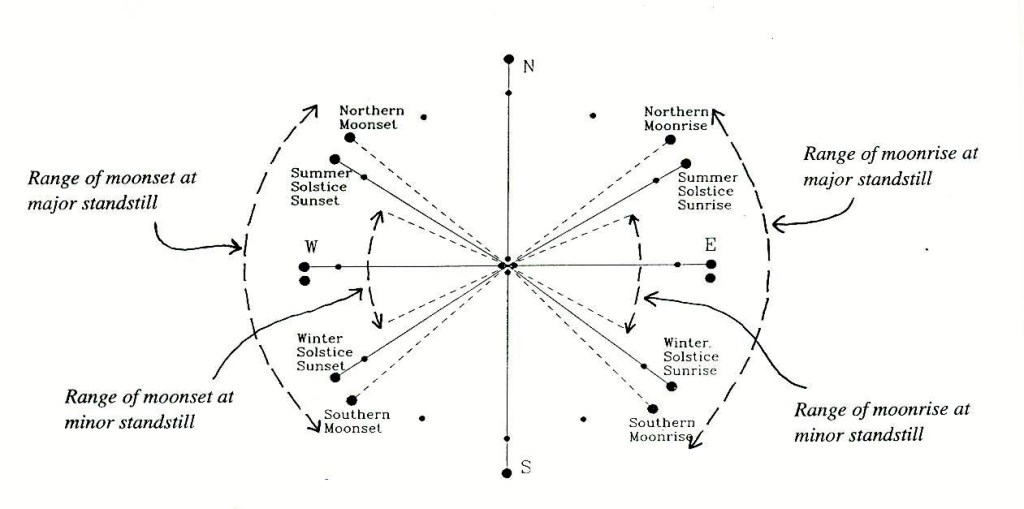
This could make the 8-Point Stone the centerpiece of a much larger astrological observatory. The hill itself is in a perfect location for such a site and its designer obviously had a very good understanding of the mechanics of the sun, the moon and probably a whole lot more – before the project started. They would have to know that everything they wanted to view… would fit at the site – there’s just too much going on here. It could be possible the Stone is the centerpiece to a much bigger device, its full dimensions yet unknown.
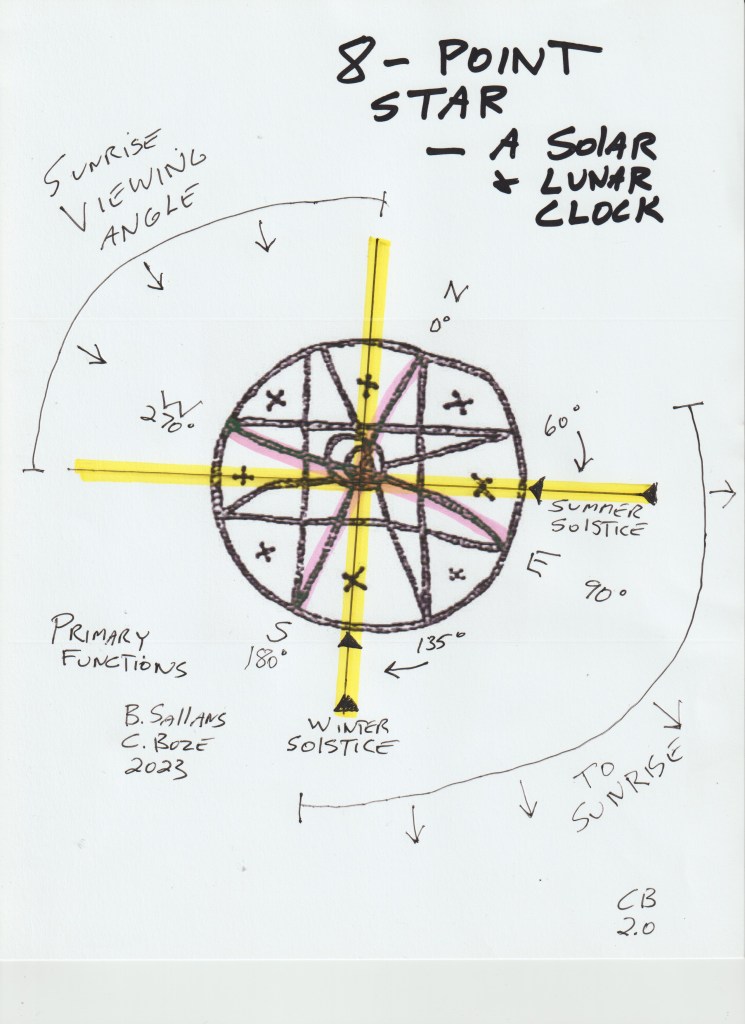
Pic 2. shows the functions for both solstices at SUNRISE positions for viewers of the Stone. The summer solstice shadow angle has been verified by modeling and compass readings at the site, but unverified by actual shadowing due to trees (Pic. 1). A generic degree for these solar events is used for the purposes of this drawing, our actual calculations and what we think they were looking at are withheld at this time. That said… the variance for solar events is only a matter of a few degrees everywhere, all over the northern half of the planet. This variance is further enhanced by the designers’ viewing site lines, of which most are presently unknown or possibly destroyed by housing. While some interesting piles have been located in positions that could be associated with noted events, the Stone likely had a system of wood posts and or rocks and possibly some of the glyphs to assist in predictions.
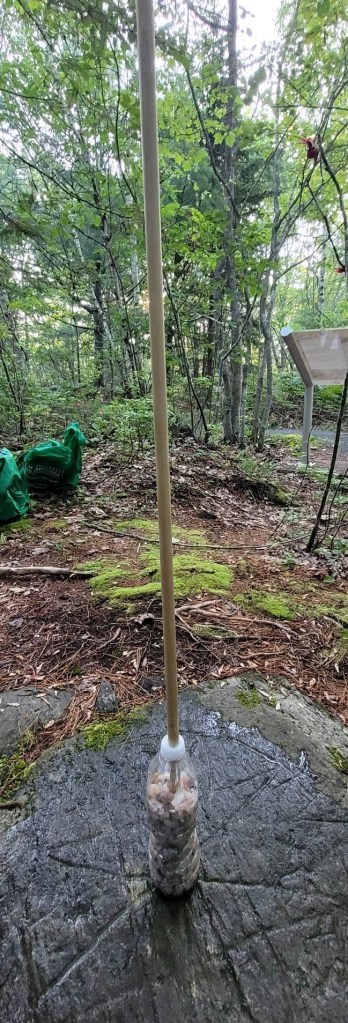
Pics. 3 & 4 are representations of what we believe the viewers of the Stone were looking for – a shadow to pass through the center of the “jaws” of the design. One direction for summer solstice sunrise and the other direction for winter solstice sunrise. Naturally, viewing locations and shadow angles will change for sunsets or other astronomy built into the site and the Stone.

The hypothesis that the 8-Point Stone is a solar and lunar calendar, will continue to be tested in the coming months. With the coming of Fall and the loss of leaf cover we hope to better document the Stone, both at the site and with modeling over time. There is more to learn from the Stone, and it is our hope that one day we generate enough evidence to get the professionals to “take a re-look” at the Bedford Barrens Heritage Site of Nova Scotia… and especially the 8-Pointed Star. Thanks for reading.
– Chris Boze / Brent Sallans, 8/15/2023
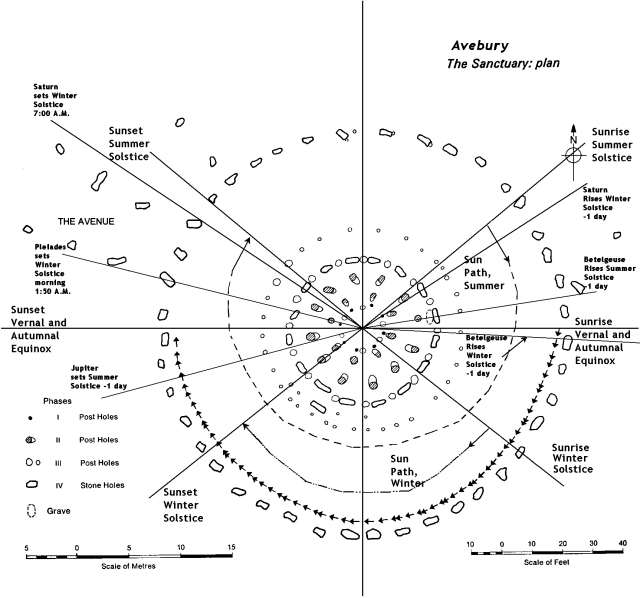
Sources:
Bedford Barrens, Bedford Halifax NS – Heritage Site of the Mi’kmaq.
Mylar tracing: R. H. Whitehead, 1983. Nova Scotia Museum, Halifax
Reference Number: P179/ N-17,124
Jack Mac Nab – collected works and videos – The Bedford Barrens 8-Point Stone.
Lunar/Solar Graphs and Pictures – MOON TEACHINGS FOR THE MASSES AT THE UMASS SUNWHEEL & AROUND THE WORLD — THE MAJOR LUNAR STANDSTILL OF 2006 Dr. Judith S. Young, Dept. of Astronomy Univ. of Mass.
Oak Island Mystery Trees and Other Forensic Answers Vol 3, 2023
 cboze research Site - Bedford barrens 8-point star
Leave a comment